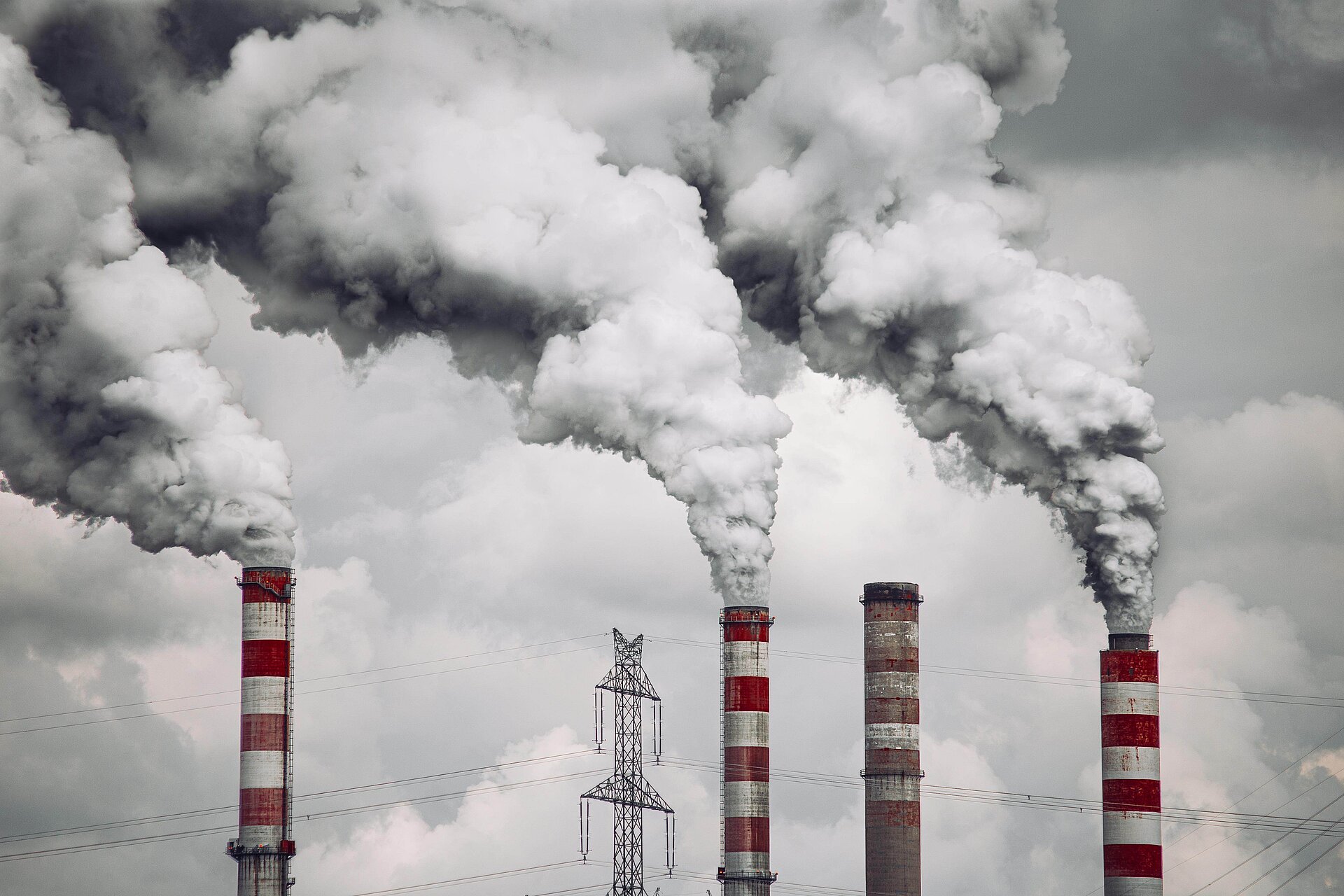
Determining the required stack height is a key task in industrial air pollution control. According to the requirements of the German Technical Instructions on Air Quality Control (TA Luft), stack height must ensure that exhaust gases are discharged unobstructed into the free air stream and sufficiently diluted. However, for installations with very low emissions or only infrequent emission events, the existing verification methods are often associated with considerable effort or may result in disproportionate structural requirements.
New Insights from Modelling Studies
In his technical article, published in issue 07-08 / 2026 of “Gefahrstoffe – Reinhaltung der Luft” by VDI-Fachmedien, our colleague Michael Kortner investigates whether, and under what conditions, sufficient dilution of exhaust gases can still be achieved even when their transport is not completely unobstructed. The study is based on extensive modelling using the atmospheric dispersion model AUSTAL, examining various building geometries, stack heights and emission rates.
Results with Practical Potential
The results show that compliance with the relevant immission requirements depends primarily on the relationship between emission strength and assessment criteria, as well as on the building arrangement and local flow conditions, particularly the extent of recirculation zones. From these findings, generally applicable relationships can be derived that may enable a simplified assessment of typical installation scenarios in the future. These insights are also intended to contribute to the development of the forthcoming guideline VDI 3783 Part 13.1.
For operators and permitting authorities, this opens up the prospect of reducing the effort involved in stack height determination for low-emission sources and, on a case-by-case basis, identifying proportionate stack heights without compromising air pollution control requirements.
Müller-BBM Industry Solutions supports companies with stack height determinations, dispersion modelling, immission forecasts and expert assessments for permitting procedures. By combining advanced modelling methods with decades of experience, we develop legally compliant, reliable and economically efficient solutions, even for complex air pollution control challenges.