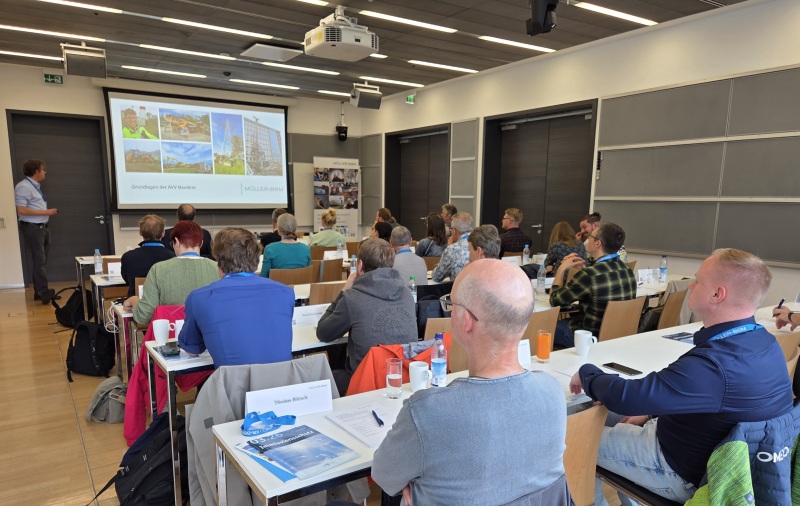
On October 14, we welcomed 25 participants to our specialist seminar ‘Immission control on construction sites – minimising risks, ensuring safe operations’ in Planegg. The level of interest demonstrated just how great the need is for practical solutions to ensure legally compliant and cost-effective construction site operations. Representatives from infrastructure companies, planning and engineering firms, public authorities, consultancy firms and legal advisory services took the opportunity to exchange expertise.
In his opening remarks, managing director Joachim Bittner made the seminar’s objective clear: “Here you will learn how to prevent adverse effects before construction work begins, and the seminar will provide you with a framework and a suitable opportunity for discussion and exchange.”
Seminar leader Andreas Lackner then introduced the programme and summed up the particular challenges of construction sites: “In our seminar, we cover all the topics that bring a construction site to life.”
It was precisely this diversity that was reflected in the specialist presentations. From the fundamentals of the AVV Baulärm (General Administrative Regulation on Protection against Construction Noise), through construction-induced vibrations and their measurement, to light and dust emissions, all key topics concerning immission control that can determine the success of a construction project in practice were covered. The aim was to provide participants with practical tools to identify risks at an early stage, avoid conflicts and manage construction sites in a legally compliant and efficient manner. The seminar covered the topics announced in the programme relating to construction noise, vibrations, measurement methods, documentation, and light and dust emissions.
Matthias Reffgen gave the first technical presentation, entitled “Fundamentals of the AVV Baulärm”. The presentation focused on examining the AVV Baulärm from a project perspective. Drawing on practical experience, he outlined requirements, typical pitfalls and possible courses of action for clients, planners and contractors.
The combination of legal, technical and practical perspectives was particularly valuable to the participants. The discussions showed that immission control is no longer a marginal issue. Particularly in the case of complex infrastructure and construction projects, immission control measures that are planned at an early stage and implemented professionally are increasingly decisive in determining whether projects can be completed on time, cost-effectively and with minimal conflict.
We would like to thank all the speakers, participants and those who contributed to the discussions for a successful seminar day and the in-depth professional exchange. The positive feedback has confirmed that this specialised seminar offers genuine added value for anyone who plans, supervises or supports construction sites and needs to implement immission control requirements reliably and in a practical manner.