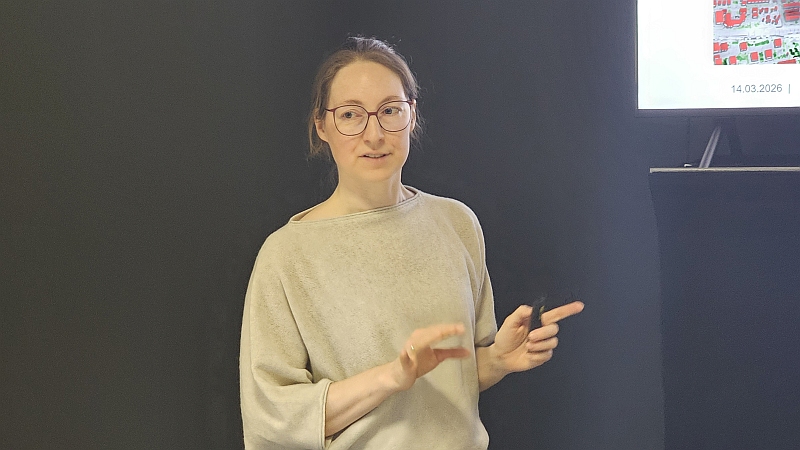
The environmental fair organized by the GemeindeZeitung took place in Landshut from 13th to 15th March. It was accompanied by the conference “Bavaria’s Best Municipal Environmental Examples,” where representatives from local governments, public administration, and the professional sector discussed current environmental and climate protection issues. Dr. Katharina Baumann represented Müller-BBM Industry Solutions GmbH with a presentation on urban climate analysis.
Her presentation focused on the question of how local governments can better cope with rising temperatures and increasing heat stress. Especially in densely built-up cities, soil sealing, poor ventilation, and additional waste heat cause urban areas to heat up significantly more than their surrounding areas. Reliable analyses of the urban climate are essential for planning effective countermeasures.
Dr. Baumann explained how urban climate analyses help identify areas within a city that are particularly affected by heat. Using numerical simulations, temperature distributions, wind conditions, and the effects of solar radiation can be visualized with spatial detail. A key evaluation criterion is the physiologically equivalent temperature (PET), which, as the “perceived temperature,” takes into account not only air temperature but also other climatic factors. This helps to identify the areas where people are actually suffering the most from the heat.
Using examples, she demonstrated just how significant the differences can be within a single city: while green spaces and parks have a cooling effect, heavily paved streets and courtyards create pronounced heat islands. For local governments, this raises specific questions — for example, regarding targeted greening, providing shade in public spaces, or designing schoolyards and recreational areas to be climate-resilient.
Another key topic of the presentation was the spatial resolution of urban climate models. High-resolution simulations provide particularly detailed and meaningful results, but they are associated with significant computational and financial demands. This is where a new approach comes in, which Dr. Baumann presented: the use of artificial intelligence for so-called super-resolution. In this process, simulations with coarse resolution are first calculated and then upscaled to a finer spatial resolution using trained neural networks.
The results presented showed that this method can produce realistic outcomes—while significantly reducing time and costs. Deviations from traditional high-resolution simulations are minimal, while computation times are considerably shorter. Furthermore, once trained, an AI model can be applied to different cities and municipalities.
This opens up new possibilities for local governments: High-resolution urban climate analyses are becoming more cost-effective, making it possible to evaluate various climate adaptation measures at an early stage and implement them in a targeted manner. The presentation at the Landshut Environmental Fair highlighted the potential that AI-supported methods offer for sustainable and climate-adapted urban development.