Grinding with vibration analyses,CPX and SPB measurements
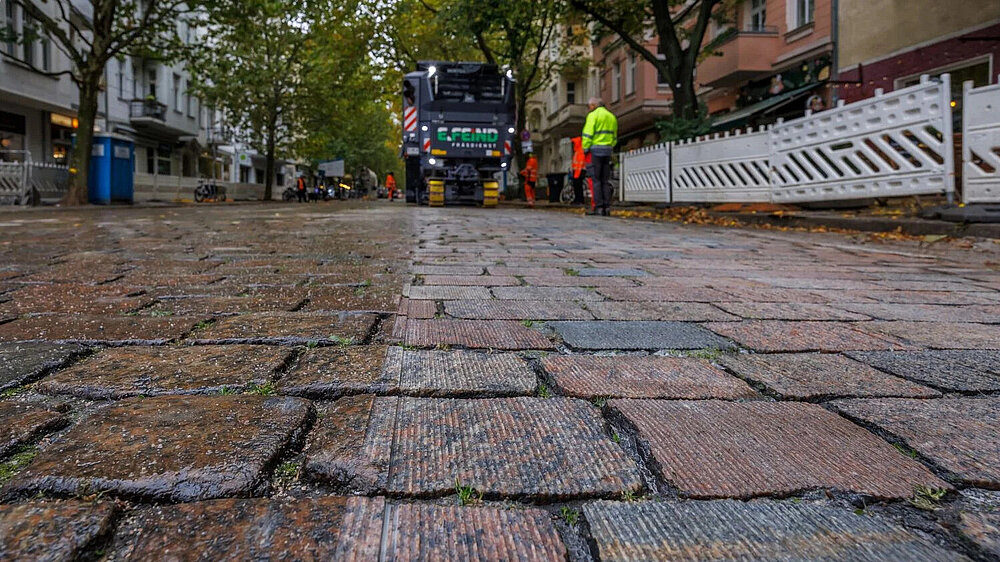
The natural stone pavement in the Berlin district of Pankow was milled using the so‑called “grinding” method. The cobblestone surface remains in place – but is processed in such a way that cycling on the roadway will be comfortable in the future. Müller‑BBM Industry Solutions was commissioned to measure the vibrations during the grinding works as well as to assess the noise exposure for the surrounding area in a before‑and‑after comparison.
At a glance
| Client: | Fräsdienst-Service E. Feind GmbH (on behalf of GB infraVelo GmbH) |
| Industry: | Construction and road building |
| Object: | Grinding of approx. 3,600 m² of large cobblestones t: up to 3 cm 1,300 m creation of a chamfer |
| Expertise: | Vibration protection, (noise) immission protection |
| Location & period: | Hufelandstraße, Pankow-Berlin measurements in October 2025 & March 2026 (two weeks of construction work) |

Initial situation
Hufelandstraße is a heavily used cycling route in Pankow, but the historic cobblestone pavement has become uneven:
height offsets and sharp edges make riding difficult, reduce comfort, and—especially in wet or dark conditions—increase the risk of falls.

Mission
By smoothing the surface and reducing the edges, the route becomes noticeably safer and more comfortable—without losing its historic character. The method is also a sustainable and cost‑efficient way to preserve the existing structure and avoid a full asphalt resurfacing and the associated surface sealing.
Measurements
Vibration measurements
During the grinding process, vibrations in the ground cannot be fully avoided – but how do they affect adjacent buildings?
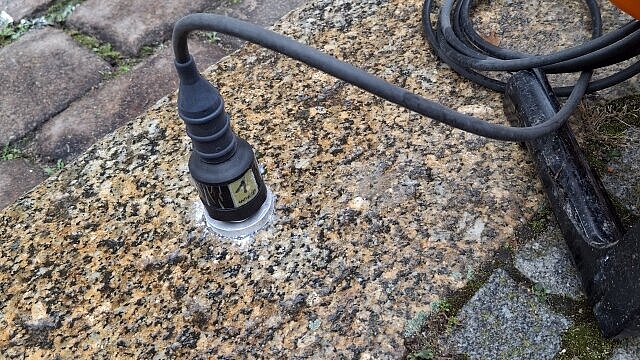
To provide clarity, we accompanied the grinding work with professional vibration measurements (vibration monitoring). We recorded the vibration immission directly at a measurement point inside a neighboring residential building and additionally carried out propagation measurements to develop reliable forecasts for the surrounding area.

CPX und SPB Measurements
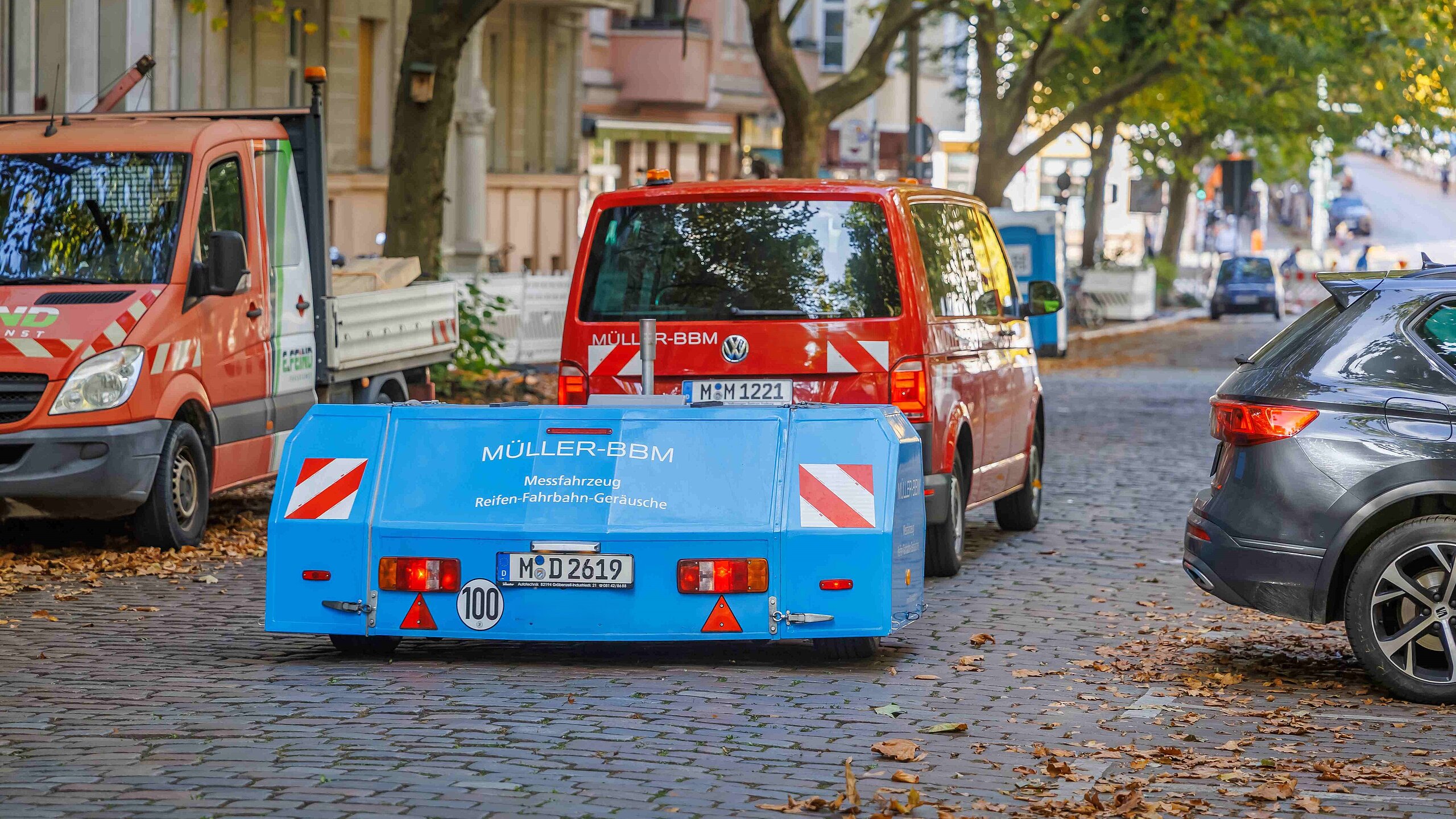
To provide proof, Close‑Proximity Measurements (CPX) were carried out using standardized passenger car and truck tires at 30 km/h. Microphones positioned directly at the tire capture the road‑tire noise level; all measurements are geo‑referenced. Complementary Statistical Pass‑By (SPB) measurements were conducted, measuring at a distance of 7.5 m from the center of the traffic lane to reflect the noise impact on pedestrians.
Amendment
Fräsdienst Feind also carried out joint rehabilitation to level the joints with the height of the paving stones. This is intended to further reduce noise emissions. A comprehensive assessment is, however, difficult, as no third measurement of this measure is planned. The final results can be compared using a similar project on Priesterweg.