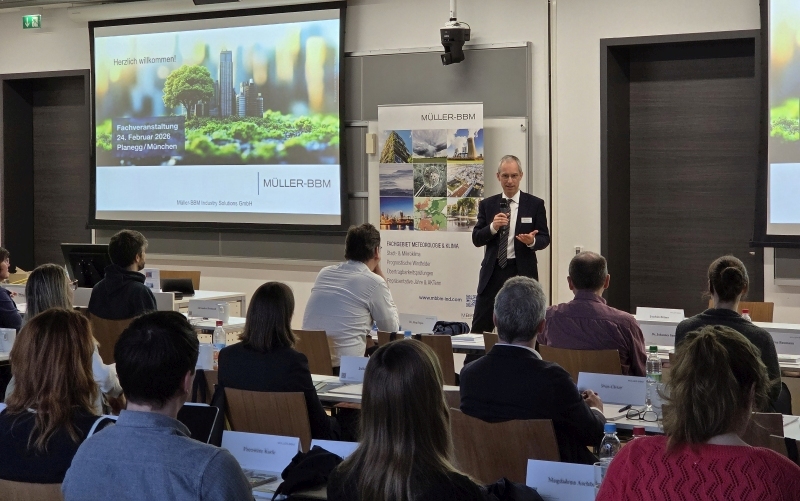
How can cities and municipalities respond effectively to the challenges of climate change? What tools are available to local authorities today – and how can they be used effectively? These questions were addressed at the specialist event ‘City.Climate.Future – Tools and approaches for municipal climate protection’, which took place in Planegg on 24th February.
About 60 participants from local authorities, government agencies and industry came together to discuss current developments, scientific findings and practical solutions. The event was attended by climate protection managers, sustainability officers, climate adaptation managers, climate networkers, urban planners, climate managers from industry and employees of consulting organisations.
After a welcome address by Dr Jörg Degen (City of Planegg), Miriam Wagner-Jacht (German Meteorological Service) opened the technical presentations with an insight into attribution research and the question of how climate change and extreme weather events can be classified scientifically.
Matthias Winkler (Fraunhofer Institute for Building Physics IBP) then demonstrated how urban climate analyses can be used with PALM‑4U in a municipal context. Complementing this, Dr Johannes Sander (Müller‑BBM Industry Solutions GmbH) presented additional tools for urban climate analysis and classified their possible applications in a practical manner.
Dr Anne von Streit (Ludwig Maximilian University) provided an overview of the status quo of municipal climate adaptation in Bavaria. Franziska Allerberger (alpS GmbH | Engineering Office for Climate Change Management) highlighted how municipalities can become climate-fit together – and what conditions are necessary for this.
Legal aspects were the focus of the presentation by Lukas Muffler (AVR – Andrea Versteyl Rechtsanwälte Partnerschaftsgesellschaft mbB), who demonstrated how climate protection can be effectively supported through urban land-use planning and urban development contracts. Dr Katharina Baumann (Müller‑BBM Industry Solutions GmbH) concluded with a presentation on super-resolution in urban climate analysis. She demonstrated how artificial intelligence methods and neural networks can be used to generate high-resolution climate data from comparatively coarse input data, thereby creating new opportunities for more precise analyses and sound decision-making in local authorities.
The event not only provided valuable expert insights, but also offered space for intensive exchange, discussion and networking. It became clear that climate protection and climate adaptation in local authorities require interdisciplinary approaches, reliable data and close cooperation between science, administration, planning and practice.
Meteorology-climate | Müller-BBM Industry Solutions | Müller-BBM Industry Solutions GmbH