Vibration analysis for adoor foaming system

After the installation of a door foaming system in which refrigerator doors are foamed on the inside, our client experienced excessive vibrations. As a result, cracks occurred and anchoring bolts became loose. Müller‑BBM Industry Solutions investigated the vibration behavior of the system and carried out comparative measurements both in Germany and abroad.
At a glance
| Industry: | Home appliance manufacturer |
| Object: | Door foaming system for refrigerators |
| Expertise: | Machine vibrations, system dynamics |
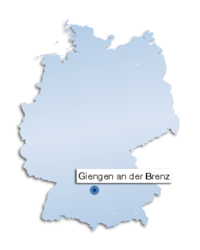
| Location & period: | Giengen an der Brenz (Baden-Württemberg) and Monterrey (Mexico) July 2025 - February 2026 |
Mexiko

Germany
Initial situation
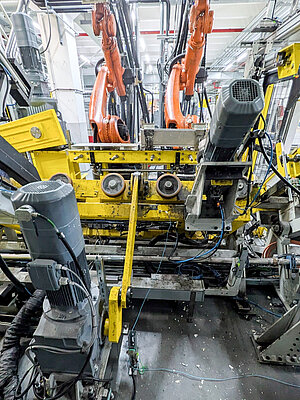
Recurring problems occurred at a system used for foaming refrigerator doors (door foaming system TSA84). In addition to repeated cracks in the steel frame, the motor consoles were affected. Furthermore, the anchoring bolts fastening the system to the concrete slab repeatedly loosened. These damage patterns indicated potentially significant dynamic loads, the causes of which required further investigation.
Mission
Müller‑BBM was commissioned to analyze the vibration situation by performing comparative measurements on the affected system as well as on properly functioning reference systems—initially in Giengen and subsequently at a further system in Mexico.
Vibration measurements
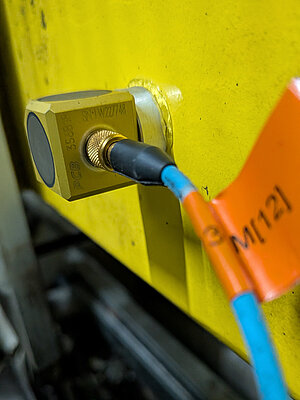
The vibration analyses included the measurement and engineering evaluation of vibrations at the system itself and on the concrete slab. In addition, the dynamic forces generated by the system were determined using an indirect method.
The investigations comprised:
- a measurement under standstill conditions (system not in operation),
- a dry run without foaming,
- measurements during the production process with foaming.
Result
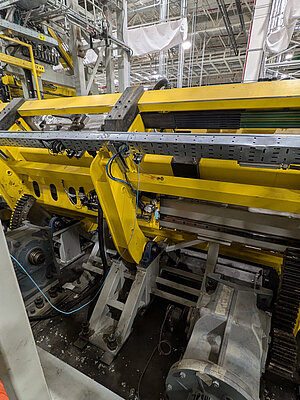
The on‑site measurements carried out in Giengen revealed very high acceleration levels, in particular with pronounced impulsive components. For comparison, measurements were performed on a system classified as “good” at the same location. At identical measurement points, significantly lower amplitudes were recorded, clearly indicating an optimized machine design.
A further comparative measurement at a technically comparable “good” system in Mexico confirmed these findings. Here as well, the amplitudes were considerably lower than those measured at the system in Giengen, providing additional insights into the structural design.
Based on these results, concrete recommendations for refurbishment and for improving the vibration performance of the Giengen system were derived.